

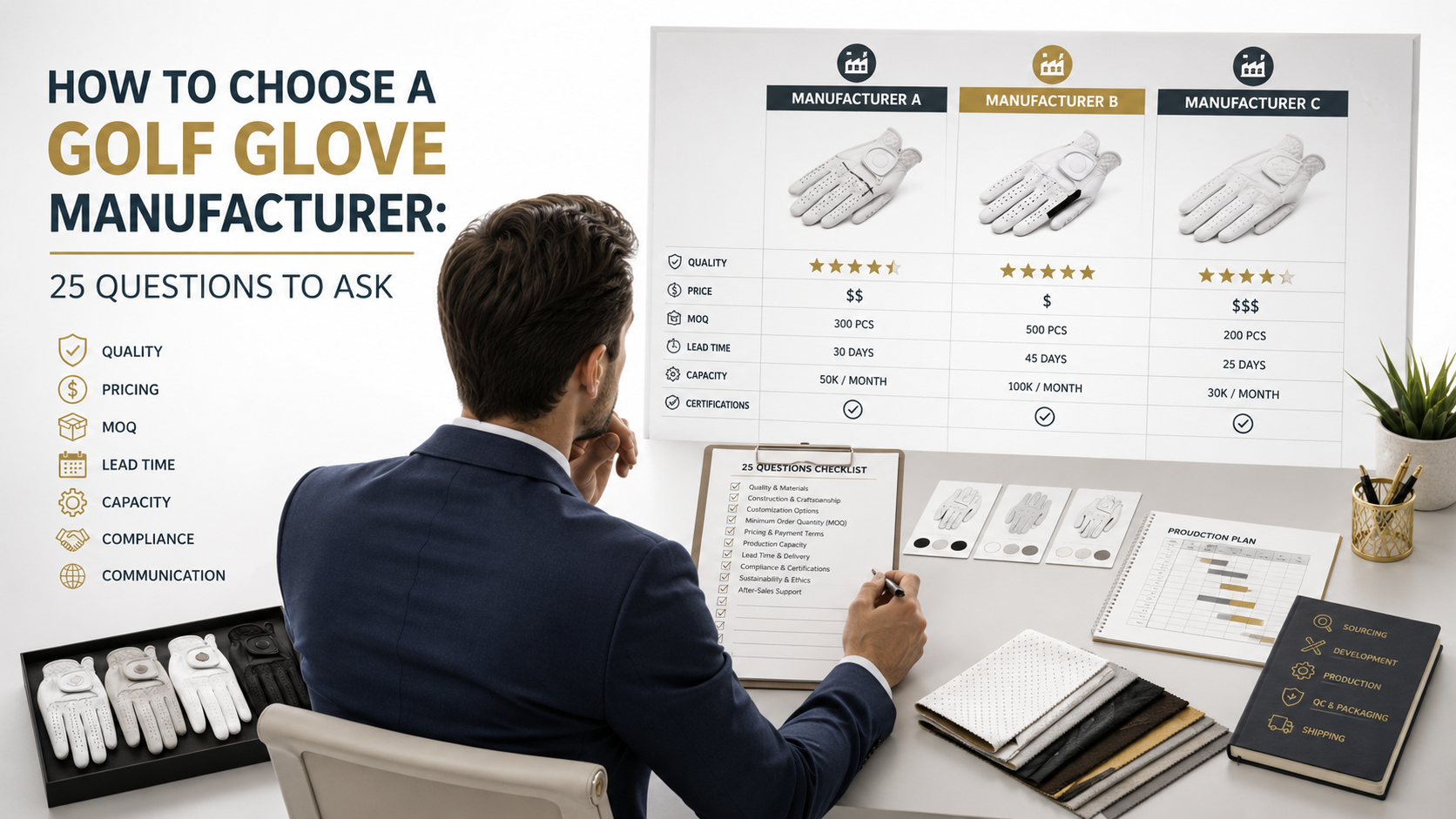
How to Choose a Golf Glove Manufacturer: 25 Questions to Ask
Direct answer: To choose a golf glove manufacturer, verify five things before comparing price: golf-glove experience, sample quality, size consistency, documented quality control, and reliable delivery. Ask for written answers, approve a physical sample, score each supplier against the same criteria, and reject any factory that avoids inspection, tolerances, or clear commercial terms.
The best supplier is not automatically the cheapest. It is the factory that can reproduce the approved glove, size matrix, branding and packaging consistently across every reorder.
⚡ Quick Answers
🔍 Compare 3–5 factories
🧤 Sample the top 2
📋 Ask 25 questions
💯 Use a 100-point scorecard
📚 Table of Contents
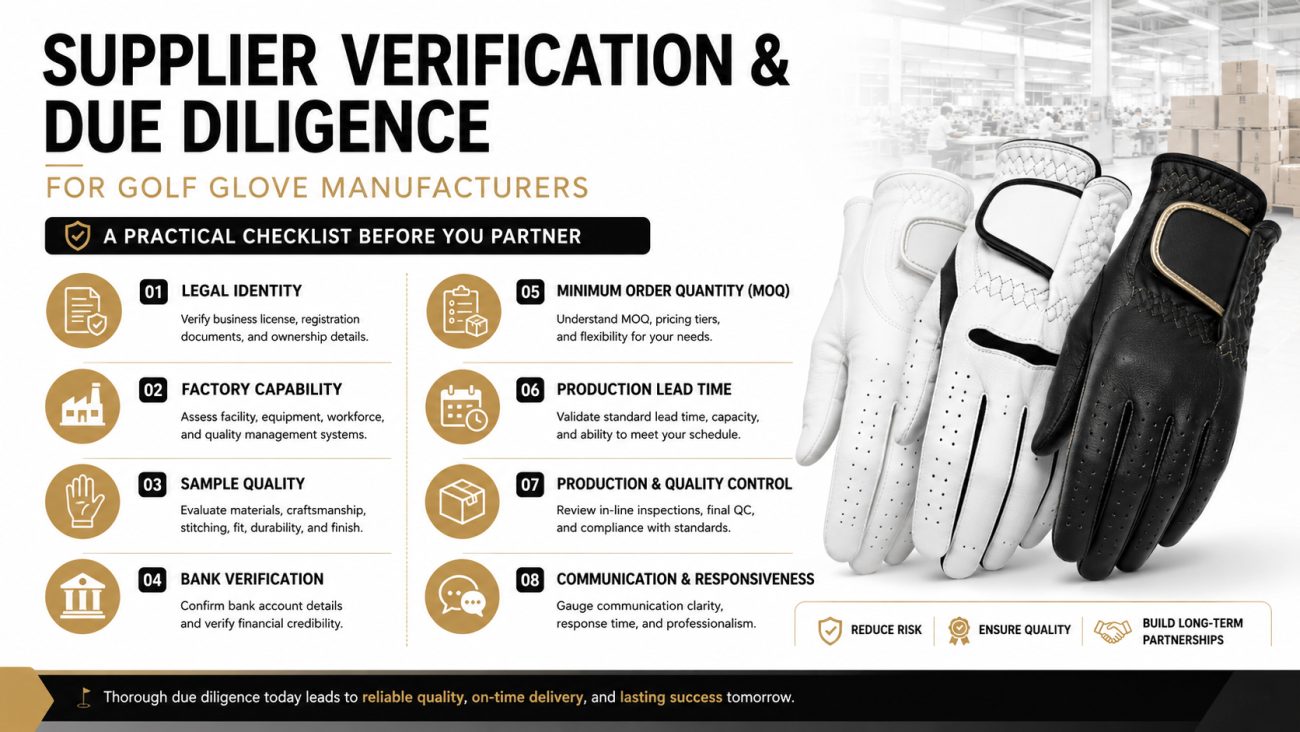
📖 How to Choose a Golf Glove Manufacturer Beyond Price
A new golf brand receives two quotations for the same glove. Factory A is USD 0.80 cheaper per pair and promises that everything is “no problem.” Factory B asks for the target golfer, palm material, pattern, size matrix, hand mix, logo dimensions, packaging and inspection method.
The cheaper supplier feels easier at first. Yet the sample arrives with long fingertips, a loose palm and an off-centre closure logo. The factory calls these “small differences.” The buyer calls them returns.
The second factory costs more, but its questions expose problems before bulk production. That is the real purpose of manufacturer selection.
The lesson
A golf glove manufacturer is not only a sewing vendor. It controls fit, grip, material consistency, branding, packaging and the evidence you will use to approve future reorders.
Choose the factory that removes uncertainty before production—not the one that creates explanations after delivery.
🧭 The 25 Questions: Start with 5 Pre-Qualification Checks
Send these five questions before requesting a quotation or sample. They remove factories that look impressive online but cannot prove relevant capability.
- How long have you manufactured golf gloves?
Ask for years of direct golf-glove experience, not general apparel or work-glove experience. - Can you show recent, unbranded examples of comparable work?
Look for similar materials, construction, sizing and finishing. Do not request another buyer’s confidential artwork. - Which processes are completed in-house?
Clarify pattern making, cutting, stitching, printing, embroidery, quality control and packing. - What is the legal company name, factory address and bank beneficiary?
All three should be consistent. Verify changes through a second communication channel. - Who is the named person responsible for sampling and bulk production?
You need one accountable contact who can explain technical decisions, not only send prices.
What strong answers look like
- Specific examples instead of broad promises
- Written processes instead of “trust us”
- Clear limits when a request is not practical
- Consistent company, address and payment details
- Willingness to accept sample approval and inspection
Stop the process early if basic verification is avoided. A sample cannot fix an unidentifiable supplier.
🔎 Questions 6–10: Verify Product and Fit Capability
A golf glove can look attractive in a photograph and still fail on the course. These five questions test whether the factory understands the product beneath the logo.
| Question | Evidence to request | Weak answer |
|---|---|---|
| 6. Which materials and grades can you source? | Named Cabretta, microfiber, synthetic and hybrid options with sample swatches | “Leather” or “best quality” without a clear specification |
| 7. Which patterns can you produce? | Standard, cadet, women’s and junior patterns with measurement charts | One generic pattern relabelled for every customer |
| 8. How do you control sizing? | Measurement points, tolerances, checking frequency and retained records | Only S, M, L and XL labels with no dimensions |
| 9. Can you manage left-hand and right-hand quantities by size? | A written SKU matrix showing glove hand, size, colour and quantity | One total quantity with no assortment control |
| 10. Which branding and packaging methods suit this construction? | Method limits, logo dimensions, colour references, labels, barcode and packaging samples | Every decoration method promised on every material |
Fit should be controlled by numbers
Ask the manufacturer to define hand length, palm width, finger proportions, closure position and allowable tolerance. A familiar size label does not prove that two production batches will fit the same.
For detailed planning, use the wholesale golf glove size-chart guide and compare Cabretta versus microfiber before approving the specification.
🧤 Questions 11–14: Control the Sample Approval Process
A digital mock-up confirms appearance. A physical sample confirms whether the factory can actually make the glove.
- What does the sample cost and what is included?
Confirm glove, logo setup, packaging, courier and any refundable development charge. - How many revision rounds are included?
Record what happens when fit, colour, logo or construction must change. - Will bulk production use the same approved materials and construction?
Require written approval before any substitution. - Will both parties retain an approved reference sample?
Give the sample, artwork, size chart and packaging specification one version number.
Approve at least 8 sample checkpoints
- Palm fit and ease
- Finger length and shape
- Thumb position and mobility
- Material feel, thickness and grip
- Seams, stitching and edge finishing
- Closure placement and wrist fit
- Logo size, colour and alignment
- Labels, individual packaging and presentation
Never approve a sample with “minor” defects that you would reject in bulk. The approved sample becomes the factory’s permission to repeat them.
📦 Questions 15–19: MOQ, Pricing, Capacity and Payment
- What is the MOQ for the complete order and for each variation?
Ask separately about material, colour, logo version, glove hand, size and packaging. A low total MOQ may still hide high per-SKU minimums. - What exactly is included in the unit price?
List material grade, branding, labels, individual packaging, cartons, inspection, export handling and Incoterm. - What is the normal production lead time and monthly capacity?
Request the production start date, completion window and the capacity available to your order. - How quickly can the factory repeat a proven order?
Ask whether approved patterns, artwork screens, colour references and packaging records are retained. - What payment schedule is proposed?
Use traceable business payments and two or three written milestones. Avoid unexplained full payment before evidence of production or inspection.
Useful planning numbers from Miraj Enterprises
| Item | Typical starting point | What can change it |
|---|---|---|
| Custom order MOQ | About 100 pairs | Material, colour, size and hand mix, logo versions and packaging |
| Sample development | About 3–7 days | Artwork readiness, revisions and material availability |
| Bulk production | About 15–25 days after approval | Order size, complexity, materials and packaging |
These are Miraj Enterprises planning ranges, not universal industry rules. Compare every supplier against the same written specification. See the full MOQ, sample-cost and lead-time guide.
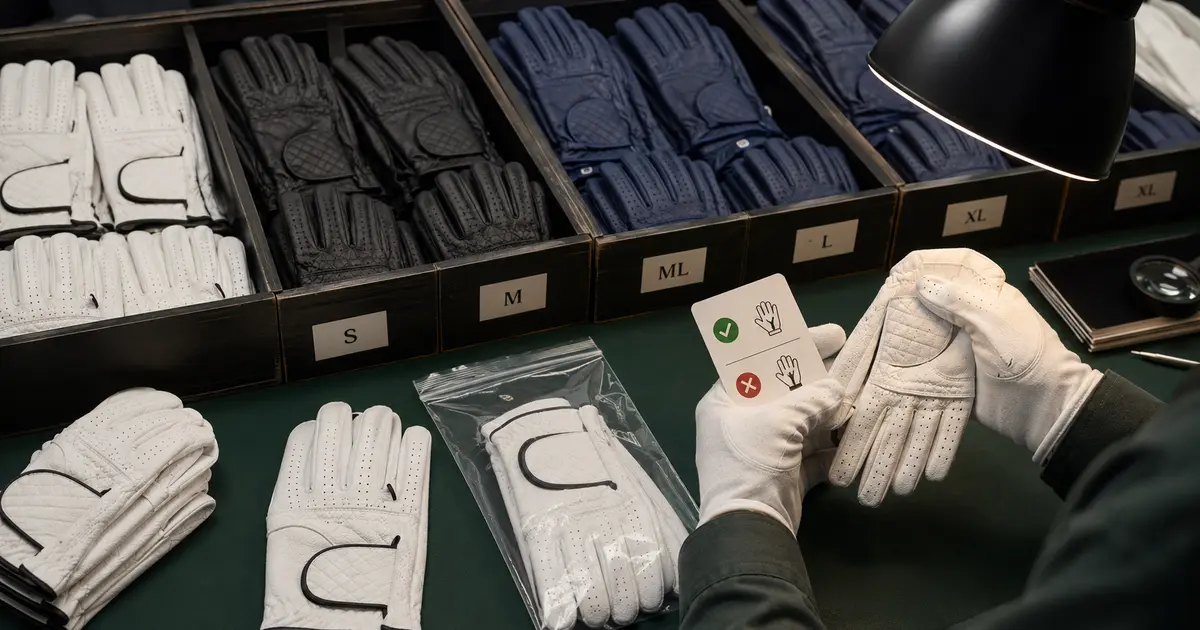
✅ Questions 20–22: Quality Control, Inspection and Remedies
- Which quality checks happen before, during and after sewing?
Ask who performs each check, how results are recorded and who can stop production. - What measurements, tolerances and defect categories will be used?
The purchase order should separate critical, major and minor defects and identify the approved reference. - Will you accept buyer or third-party inspection before shipment?
Confirm inspection timing, access, sample-selection method, responsibility for failed results and re-inspection cost.
A practical inspection trail
| Stage | Evidence to request | Main risk controlled |
|---|---|---|
| Incoming material | Material identity, colour and visible-quality check | Unapproved substitution |
| Cutting | Pattern and component verification | Size and shape inconsistency |
| Stitching | Seam, skipped-stitch and workmanship checks | Premature failure and poor appearance |
| Measurement | Recorded checks by size against tolerances | Loose palms and incorrect finger lengths |
| Branding | Logo position, size and colour reference | Off-centre or inconsistent decoration |
| Final packing | SKU, hand, size, quantity, labels and carton check | Assortment and fulfilment errors |
Write 4 remedies into the agreement
- Rework before shipment
- Replacement of affected units
- Commercial credit agreed in writing
- Shipment hold until an acceptable solution is confirmed
If an AQL sampling plan is used, agree the referenced standard, inspection level and acceptance limits with the inspector before production. Review Miraj’s production and quality process for additional context.
🌍 Questions 23–25: Export Readiness and Communication
- Which export documents can you prepare accurately?
At minimum, discuss the commercial invoice, packing list, air waybill or bill of lading, purchase order and any destination-specific origin or inspection document. - How will product descriptions, origin marks, labels and Incoterms be confirmed?
Require the exact Incoterm and named place. Ask your broker to confirm tariff classification and destination rules before shipment. - What is the communication and escalation plan?
Set update dates for material approval, cutting, stitching, branding, packing, inspection and dispatch. Name the person who resolves delays or failed checks.
Compare the full commercial offer
| Cost or responsibility | Question to ask |
|---|---|
| Product | Does the quote use the approved material, construction and size matrix? |
| Branding | Are setup, logo application, labels and colour matching included? |
| Packaging | Are individual packs, barcodes, retail cards and cartons included? |
| Inspection | Who pays for inspection, failed inspection and re-inspection? |
| Delivery | Which Incoterm, named place and destination charges apply? |
| Risk | What happens if material, quality, quantity or timing differs from the agreement? |
Location helps, but process decides
Sialkot, Pakistan is an established export-manufacturing location for sporting goods, and Miraj Enterprises produces golf gloves there. Buyers may also compare factories in other Asian manufacturing hubs. Do not choose a country name alone. Choose the factory that can prove product knowledge, repeatable fit, quality records and export discipline.
For the logistics stage after selection, use the guide to importing custom golf gloves from Pakistan.
💯 Use a 100-Point Golf Glove Manufacturer Scorecard
Do not rank suppliers from memory or enthusiasm. Give every candidate the same 100 available points and record the evidence behind each score.
| Category | Points | Evidence that earns the score |
|---|---|---|
| Golf-glove expertise | 20 | Relevant experience, comparable samples, clear material and construction knowledge |
| Sample, fit and sizing | 20 | Accurate sample, measurement chart, tolerances, pattern options and repeatable hand-size matrix |
| Quality system | 20 | Documented checks, defect criteria, records, retained sample and inspection acceptance |
| Commercial clarity | 15 | Transparent MOQ, inclusions, payment milestones, remedies and written quotation |
| Capacity and delivery | 10 | Realistic lead time, available capacity, milestone plan and reorder control |
| Export and communication | 10 | Accurate documents, named contact, update schedule and escalation route |
| Ethics and compliance | 5 | Traceable business identity, responsible workplace answers and willingness to document claims |
| Total | 100 | Score proof, not promises |
How to interpret the total
- 85–100: strong shortlist candidate; confirm with sample and commercial checks
- 70–84: proceed only with a controlled pilot and written risk controls
- 55–69: sample or re-verify before discussing bulk production
- Below 55: reject unless major evidence changes the score
Illustrative comparison
Factory A quotes USD 0.80 less but scores 68 because it has no measurement tolerances, weak inspection answers and unclear packaging costs. Factory B scores 87 with a better sample, documented checks and clear delivery milestones. The higher unit price may be the lower-risk and lower-total-cost choice.
The scorecard is a decision tool created for buyer comparison, not an industry certification.
🚩 10 Red Flags and a Final 12-Point Checklist
10 red flags
- The bank beneficiary does not match the contracting business.
- The supplier pressures you to skip a physical sample.
- Material descriptions use vague words such as “premium” without grades or references.
- No measurement chart or tolerance is available.
- The factory refuses buyer or third-party inspection.
- The quotation omits logo setup, labels, packaging or the Incoterm.
- Production time changes repeatedly without a capacity explanation.
- Full payment is demanded before evidence of production or inspection.
- Company name, address, contact details or payment instructions keep changing.
- The price is far below comparable quotes but the specification is supposedly identical.
12-point final decision checklist
- Legal identity and factory location verified
- Relevant golf-glove experience demonstrated
- Comparable sample approved
- Material and construction specification signed off
- Size chart, tolerances and hand-size matrix approved
- Branding, labels and packaging approved
- MOQ and per-variation minimums understood
- Unit-price inclusions and payment milestones written
- Production capacity and milestone dates confirmed
- Quality plan, defect criteria and remedies agreed
- Inspection access confirmed
- Export documents, Incoterm and communication route confirmed
Do not place the bulk order until every unchecked item has an owner, a deadline and written evidence.
❓ Frequently Asked Questions
🔗 Authoritative Golf and Sourcing Resources
- USGA Equipment Standards — official equipment rules, testing and manufacturer resources.
- The R&A — golf rules and equipment-governance information.
- Golf Monthly glove testing — consumer fit, material and performance context that helps buyers define a better product brief.
- International Trade Administration — common export-document guidance.
- ICC Incoterms — official delivery-responsibility rules.
- Pakistan Single Window — Pakistan-side digital trade information.
Important: Confirm the product, legal, customs, labelling and social-compliance requirements that apply in your target market. A supplier’s general assurance is not a substitute for market-specific professional advice.