

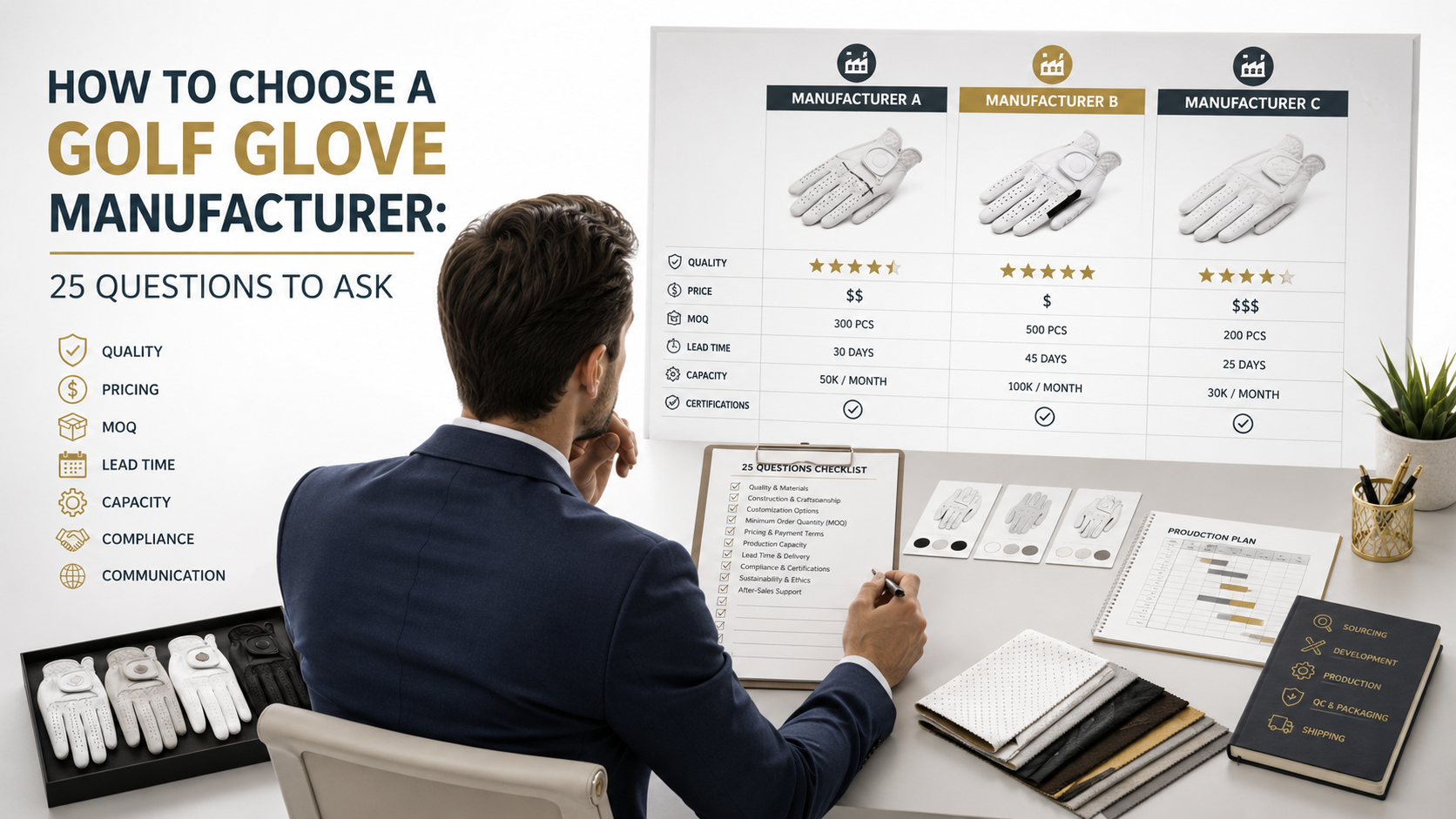
Golf Glove Manufacturer FAQ: MOQ, Materials, Sizes, Branding & Shipping
Direct answer: A reliable golf glove manufacturer should explain MOQ by design and variation, recommend materials for your price and performance target, provide a measurable size-and-hand matrix, approve branding and packaging through a physical sample, inspect bulk production, and quote shipping with clear Incoterms. Buyers should compare the complete specification and landed cost—not only the price per pair.
A buyer once asked us for a price on “500 custom golf gloves.” It sounded complete, but the request still left more than ten decisions open: Cabretta or microfiber, men’s or women’s pattern, left-hand or right-hand glove, sizes, logo method, packaging, destination, inspection and delivery date.
That is why good manufacturer FAQs matter. They turn a vague inquiry into a quote that can actually be compared. This guide answers the questions buyers usually ask before sampling, ordering or shipping private-label and OEM golf gloves.
Manufacturer insight: The fastest project is rarely the one with the shortest email. It is the one with the clearest specification.
⚡ Quick Answers for Buyers
| Buyer question | Practical starting answer |
|---|---|
| Typical MOQ | At Miraj Enterprises, many custom programs start around 100 pairs, subject to material, colors, size and hand mix, logos and packaging. |
| Sample time | About 3–7 days after the specification, artwork and available materials are confirmed. |
| Bulk production | About 15–25 days after physical sample approval for many standard programs. |
| Main materials | Cabretta leather, microfiber or synthetic constructions, and hybrid combinations. |
| Branding | Printing, embroidery, embossing, debossing, woven labels, patches and custom packaging—depending on construction. |
| Shipping | Courier for samples, air for time-sensitive commercial orders, and sea for larger less-urgent shipments. |
These are planning ranges, not universal promises. Your written quotation and approved sample control the final order.
📦 About 100 pairs
🧤 3–7 day sample
🏭 15–25 day production
✈️ Courier, air or sea
📚 Table of Contents
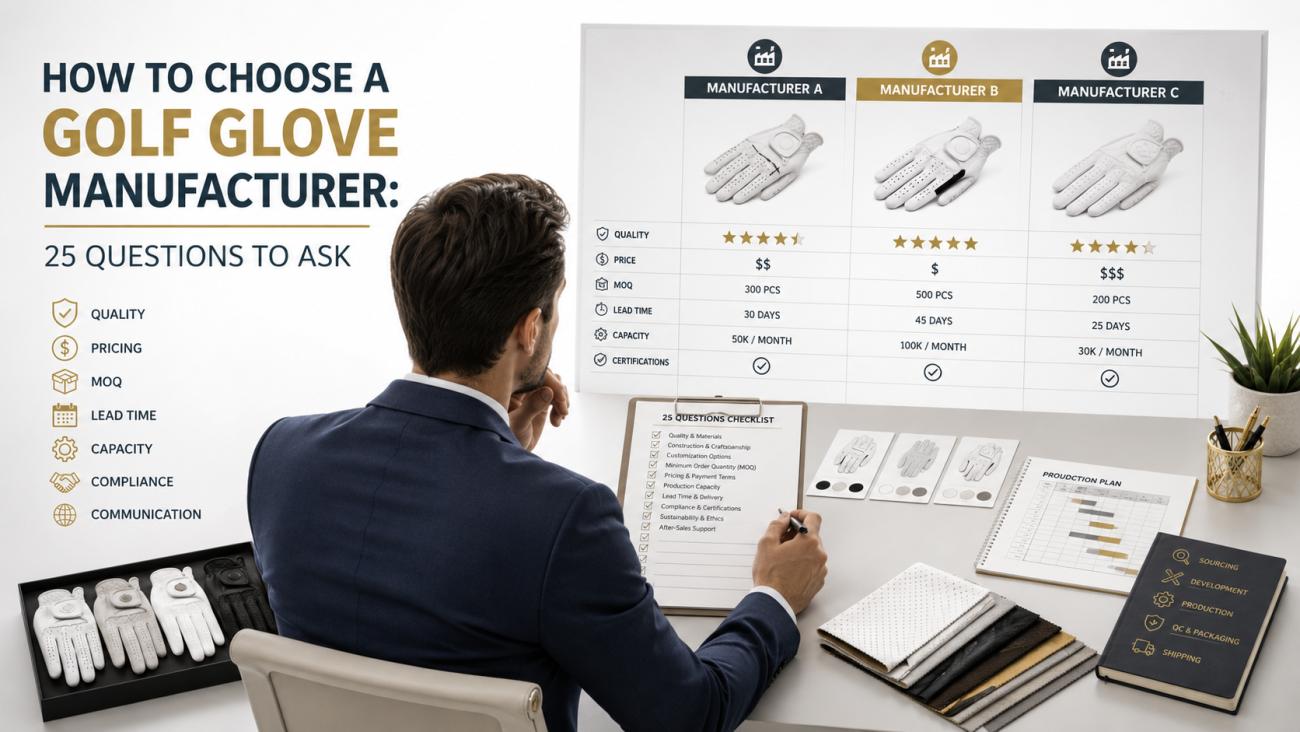
📦 MOQ and Pricing Questions
Golf glove MOQ is not one number. A factory may have a total-order minimum and separate minimums for the material, color, logo version, hand orientation, size assortment or packaging style.
What should buyers ask about MOQ?
- Is the MOQ per order, per design or per color?
- Can the quantity be divided across S–XXL?
- Can left-hand and right-hand gloves share the same MOQ?
- Does a second logo or package create another minimum?
- Will the same material be available for reorders?
Can MOQ be negotiated?
Sometimes. The most practical negotiation is not simply “make fewer.” Ask whether you can use a standard base pattern, one material, fewer colors, one logo method and simple packaging. This reduces setup changes and leftover materials.
What should be included in the price?
Request a line-by-line scope covering the glove material, construction, logo setup, branding application, labels, individual packaging, export cartons, inspection, export handling and Incoterm. A low unit price can become expensive when these items appear later.
For detailed numbers and timing, read the golf glove MOQ, sample-cost and production lead-time guide.
🧤 Golf Glove Materials
Material choice should follow the target customer, climate, price position and expected wear—not a single claim such as “premium.”
| Material | Best suited to | Main advantage | Buyer check |
|---|---|---|---|
| Cabretta leather | Premium retail, club shops and feel-led products | Soft hand feel and close connection to the grip | Confirm grade, thickness, color consistency and storage |
| Microfiber / synthetic | Value-focused, durable and repeatable programs | More consistent specifications and easier color control | Approve grip, flexibility, breathability and surface finish |
| Hybrid | Balanced performance and cost | Premium material in key areas with synthetic support elsewhere | Mark every panel and material on the approved specification |
Is Cabretta always better?
No. Cabretta is often preferred for softness and premium feel, but it can be a poor commercial choice when the target price, climate, storage conditions or durability expectation favor microfiber. The best material is the one that consistently meets the buyer’s product promise.
What material information should appear on the specification?
- Material name and grade
- Supplier reference or approved swatch
- Thickness or performance range where relevant
- Color reference
- Palm, backhand, gusset and reinforcement locations
- Substitution rules
Use the deeper Cabretta versus microfiber comparison before approving a sample.
Common buyer mistake: Approving a sample by appearance while leaving the bulk material description vague.
📏 Golf Glove Sizing and Hand Orientation
Golf glove sizing is more than S, M, L and XL. A repeatable order needs a measurement chart, fit description, allowable tolerance, hand orientation and quantity by size.
Which measurements matter?
- Hand length from wrist reference to middle fingertip
- Palm width
- Finger length and proportion
- Thumb position
- Wrist opening and closure placement
- Finished-glove tolerance
What is a size-and-hand matrix?
It is a table that separates every SKU by size and whether the glove is worn on the left or right hand. A buyer ordering “500 mixed sizes” has not provided enough information for accurate production or packing.
| SKU | Glove worn on | Size | Quantity |
|---|---|---|---|
| WG-LH-M | Left hand | Medium | 80 |
| WG-LH-L | Left hand | Large | 120 |
| WG-RH-M | Right hand | Medium | 40 |
| WG-RH-L | Right hand | Large | 60 |
How do manufacturers maintain sizing across reorders?
Keep the approved pattern, measurement chart, tolerance, physical reference sample and inspection record under one version number. Reconfirm them before each reorder, especially if material or construction changes.
See the wholesale golf glove size-chart guide for deeper planning.
🏷️ Branding, OEM, ODM and Private Label
Custom branding can include more than a closure-tab logo. Buyers may customize colors, stitching, perforations, labels, inserts, barcodes, retail packaging and carton marks.
| Branding method | Strength | Watch for |
|---|---|---|
| Good detail and color flexibility | Adhesion, stretch and abrasion on the selected surface | |
| Embroidery | Premium textile appearance | Bulk, stiffness and stitch density on small areas |
| Emboss / deboss | Clean tonal branding | Material suitability and readable depth |
| Woven label | Consistent brand detail | Placement, edge comfort and minimum label quantity |
| Rubber or molded patch | Strong visual identity | Tooling, weight, flexibility and lead time |
What is the difference between OEM, ODM and private label?
- OEM: the factory manufactures to the buyer’s agreed specification or design.
- ODM: the factory provides a base design or development direction that the buyer adapts.
- Private label: the product is sold under the buyer’s brand. A project may be both OEM and private label.
Which artwork files should buyers send?
Vector artwork is preferred for logos and packaging. Include the logo file, exact dimensions, placement, color references and a mock-up. Do not rely on a low-resolution screenshot.
Review the private-label and OEM golf glove process and customization options.
⏱️ Samples, Production Time and Delays
A sample is not a souvenir. It is the physical contract for fit, material, workmanship, branding and packaging.
What should a sample request include?
- Reference image or existing glove
- Target market and price position
- Material and construction
- Hand orientation and sizes
- Logo files and placement
- Labels and packaging
- Destination and target date
What should buyers approve?
- Palm fit and finger length
- Thumb position and wrist opening
- Material feel, grip and flexibility
- Stitching, seams and edge finishing
- Perforation and stretch zones
- Closure and logo alignment
- Labels, barcode and package
How long does production take?
At Miraj Enterprises, sample development commonly takes about 3–7 days after details are confirmed, and many standard bulk orders take about 15–25 days after physical sample approval. These are planning ranges. Material sourcing, multiple revisions, molded branding, complex packaging and peak capacity can extend them.
What commonly causes delays?
- Late artwork or color approval
- Changing material after sampling
- Incomplete size-and-hand quantities
- Too many small variations
- Unapproved packaging
- Delayed payment milestone
- Inspection failure or rework
- Incorrect consignee or shipping documents
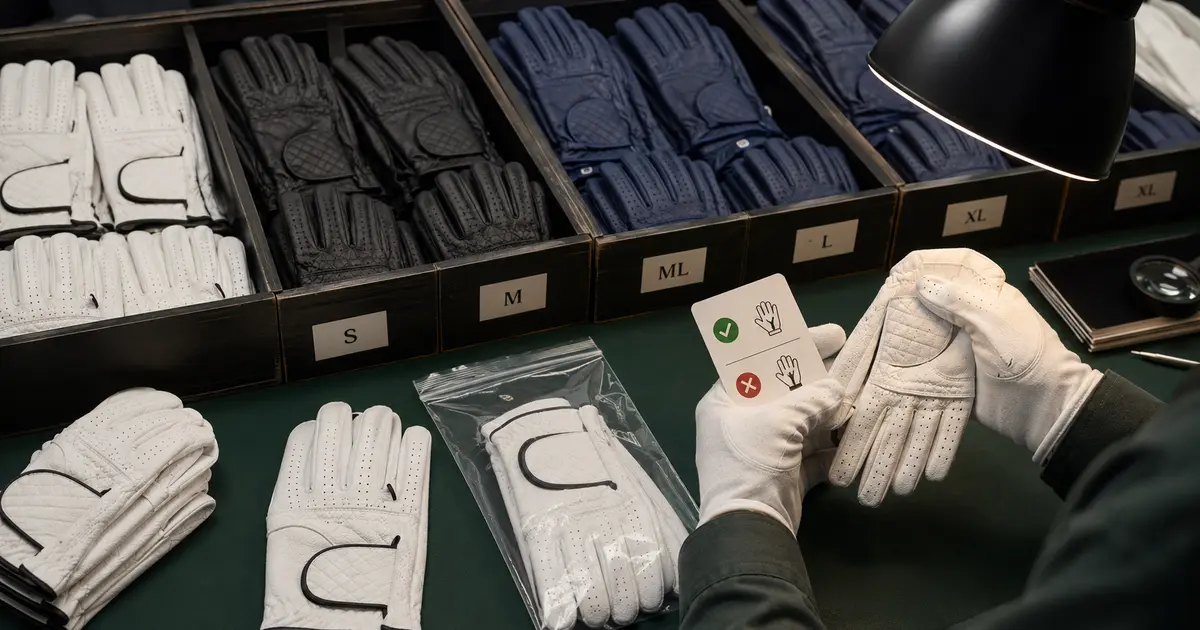
✅ Quality Control and Inspection
Quality control should be a written sequence, not a promise that “we check everything.”
| Stage | Typical check | Risk controlled |
|---|---|---|
| Incoming material | Identity, color, visible defects and approved reference | Unapproved substitution |
| Cutting | Pattern, direction and component count | Fit and shape variation |
| Stitching | Seams, skipped stitches, tension and workmanship | Failure and poor appearance |
| Measurement | Finished dimensions by size | Inconsistent fit |
| Branding | Logo size, placement and color | Brand inconsistency |
| Final packing | Size, hand, SKU, quantity and carton marks | Fulfilment errors |
Can buyers arrange third-party inspection?
Yes, when agreed before production. The purchase order should state the inspection timing, sampling method, defect categories, acceptance limits, access, re-inspection cost and remedies.
What happens if an order fails inspection?
Possible remedies include rework, replacement, a commercial credit or holding shipment until a written solution is approved. The agreement should define responsibility before the order begins.
Do golf gloves need to follow golf equipment rules?
Designers should review the official glove provisions in the USGA Equipment Rules and the R&A Equipment Rules. The rules describe a “plain” glove and restrict features that provide prohibited assistance. A formal conformance claim should not be made without the appropriate official determination.
See Miraj Enterprises’ production and quality process.
✈️ Packaging, Shipping and Import Questions
Shipping cost depends on the destination, carton count, carton dimensions, actual weight, dimensional weight, Incoterm and service—not only the number of gloves.
| Method | Best use | Buyer consideration |
|---|---|---|
| Courier | Samples and small urgent shipments | Fast and simple, but dimensional weight can matter |
| Air freight | Time-sensitive commercial orders | Compare airport and destination handling charges |
| Sea freight | Larger, less urgent orders | Longer transit and more destination coordination |
Why can packaging increase freight cost?
Golf gloves are light, so oversized retail boxes and loose export cartons can be billed by dimensional weight. FedEx and UPS explain that carriers may charge the greater of actual or dimensional weight. Compact approved packaging can reduce the cost of shipping empty space.
Read the official FedEx dimensional-weight guide and UPS dimensions and weight guidance.
Which Incoterm should be used?
The best rule depends on who controls freight, export handling, import clearance and destination charges. Always write the Incoterm, exact named place and version in the quotation and purchase order. Do not accept a three-letter term without the named location.
What documents are commonly required?
- Purchase order or contract
- Commercial invoice
- Packing list
- Air waybill or bill of lading
- Origin, inspection or market-specific documents where required
For the full logistics workflow, use the guide to importing custom golf gloves from Pakistan.
⚠️ Common Buyer Mistakes and Low-Risk Ordering
Most sourcing problems are not caused by one dramatic mistake. They come from small assumptions that were never written down.
10 common buyer mistakes
- Requesting one unit price without a complete specification
- Splitting a small first order across too many colors and logos
- Approving only a digital mock-up
- Sending no size-and-hand quantity matrix
- Using vague material terms such as “premium leather”
- Leaving inspection criteria and remedies unwritten
- Confusing shipment date with arrival date
- Ignoring carton dimensions before choosing freight
- Accepting changed payment details without verification
- Making production changes through chat without updating the purchase order
A lower-risk ordering sequence
- Written brief: define the market, glove, quantities, branding, packaging and deadline.
- Paid sample: test the physical product rather than relying on a rendering.
- Approved version: lock the sample, artwork, measurements and packaging under one version number.
- Production and inspection: receive milestone updates and inspect before dispatch.
- Freight and document review: check the Incoterm, cartons, invoice, packing list and consignee details.
Educate first, approve second, scale third. That sequence is slower than guessing and much faster than correcting a failed bulk order.
📋 Buyer Checklist Before Ordering
Product
- Target customer and price position
- Material and construction
- Size chart and tolerances
- Left/right-hand quantity matrix
Brand
- Vector logo and colors
- Branding method and placement
- Labels, barcode and origin marks
- Individual and retail packaging
Commercial
- MOQ by variation
- Price inclusions
- Payment milestones
- Lead time and production slot
Quality & delivery
- Approved physical sample
- Inspection plan and remedies
- Carton dimensions and marks
- Incoterm, destination and deadline
Before placing the order: every unchecked item should have an owner, a deadline and written evidence.
❓ Frequently Asked Questions
🔗 Authoritative Resources
- USGA glove equipment rule — official requirements for a plain golf glove.
- The R&A Equipment Rules — official equipment-governance resource.
- FedEx dimensional weight — why package volume can affect freight cost.
- UPS shipping dimensions and weight — official billable-weight guidance.
Product, customs, tax, labelling and compliance requirements vary by market. Confirm current requirements with the relevant authority, broker or professional adviser.
Ready to Plan a Low-Risk Order?
Share your target market, material direction, quantity, size-and-hand matrix, logo files, packaging and delivery date. Miraj Enterprises can reply with a practical sample plan, quotation scope and production timeline.
Educate first, approve second, scale third. That sequence reduces the risk of paying for a bulk order that has not been fully defined.