

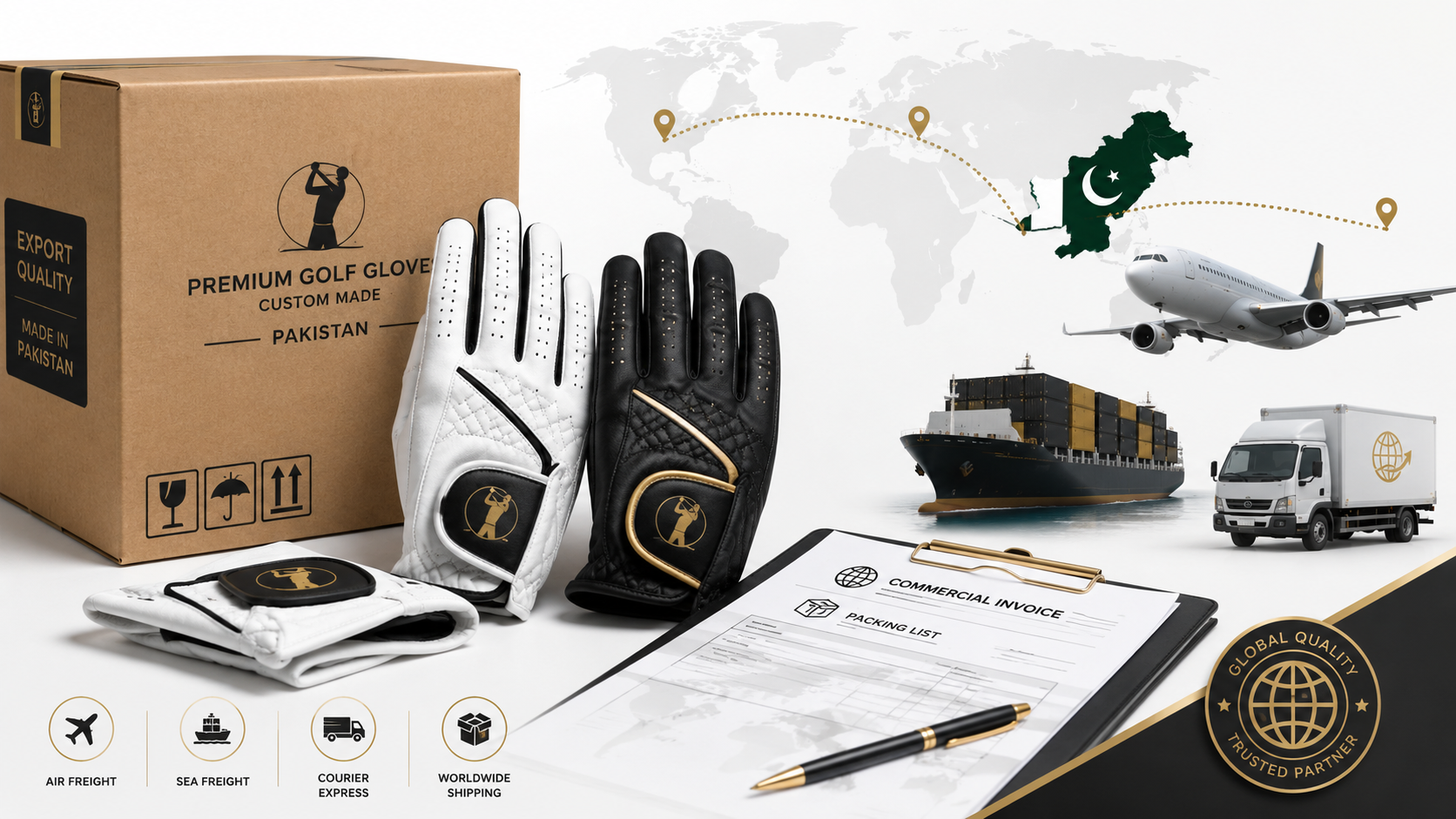
How to Import Custom Golf Gloves from Pakistan
Direct answer: Define the glove and destination first, verify the manufacturer, approve one physical sample, agree the MOQ and Incoterm, calculate landed cost, inspect bulk production, and prepare matching commercial, packing and transport documents.
Your customs broker should confirm tariff classification, duty, tax and importer-of-record requirements before shipment.
⚡ Quick Answers
📦 About 100 pairs
🧤 3–7 days
🏭 15–25 days
🌍 4–8 weeks
📚 Clickable Table of Contents
📖 The Shipment Problem Usually Starts Before Shipping
Imagine a new golf brand placing its first overseas order. The photographs look polished, the unit price is attractive and the buyer starts planning the launch.
Weeks later, the cartons arrive. Finger length feels inconsistent. The glove-hand labels confuse customers. Customs asks for a clearer material description than “sports gloves.”
None of these problems began at the border. They began when the product specification, hand-and-size matrix, customs description and approval process were left vague.
Connect four systems from the start
- Product: material, fit, construction, branding and packaging.
- Commercial: MOQ, price, payment, inspection and remedies.
- Logistics: Incoterm, freight mode, cartons, insurance and arrival date.
- Customs: classification, value, origin, importer details and documents.
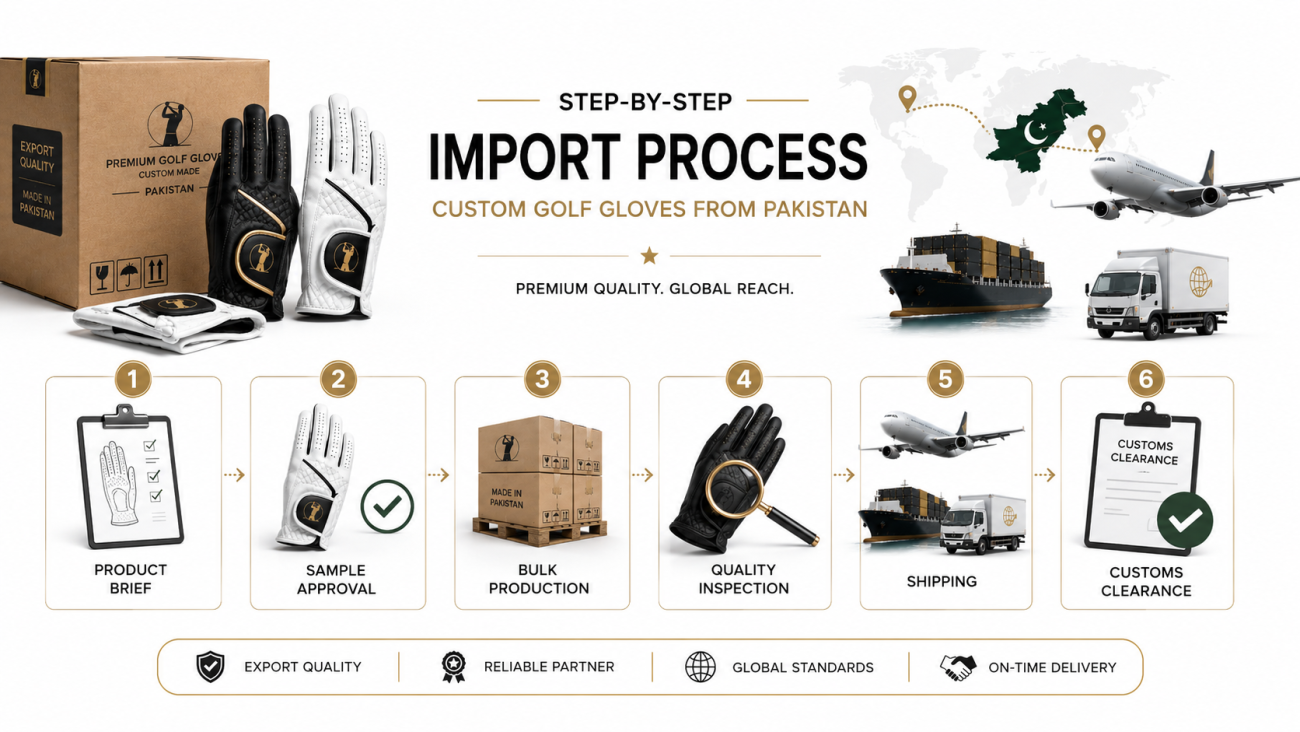
🧭 A 12-Step Import Process
- Confirm destination requirementsIdentify the importer, broker, tariff database and labelling rules.
- Define the productWrite the material, sizes, glove hands, colours, logo, labels and packaging.
- Shortlist manufacturersCompare golf-glove experience, samples, quality records and export readiness.
- Verify the supplierConfirm legal identity, location, bank beneficiary and production capability.
- Send a complete RFQRequest sample cost, MOQ, unit tiers, packaging, payment, Incoterm and timing.
- Develop and test a sampleReview fit, finger length, thumb position, material, stitching, closure and branding.
- Estimate landed costAdd freight, duty, tax, brokerage, inspection and local delivery.
- Agree the contractRecord the approved sample, price, payment, inspection method, remedies and schedule.
- Authorize bulk productionRelease production only after every artwork and assortment approval.
- Inspect before shipmentCheck workmanship, measurements, branding, packing and quantities.
- Review freight and documentsMatch the invoice, packing list, transport document and consignee details.
- Clear, receive and recordDocument shortages or damage and preserve the specification for reorders.
🔎 Verify the Golf Glove Manufacturer
A professional website is useful, but it is not enough. Verification should connect the supplier’s legal identity, production capability, bank information and actual product sample.
| Verification area | Evidence to request | What it proves |
|---|---|---|
| Legal identity | Registered business name, address and named contact | The contracting party is identifiable |
| Factory capability | Current production evidence, machinery and relevant samples | The supplier can make the product at scale |
| Bank beneficiary | Business banking details confirmed through a second channel | Payment goes to the expected party |
| Golf-glove experience | Samples, size charts and material explanations | The team understands fit, handedness and construction |
| Quality system | Approved-sample process, measurements and inspection plan | Quality is recorded rather than promised verbally |
| Export readiness | Example invoice, packing list and carton workflow | The team understands export coordination |
| Inspection acceptance | Written permission for buyer or third-party inspection | The bulk order can be checked before dispatch |
🧤 Build an Import-Ready Product Specification
The factory quotation, customs description and inspection checklist cannot be accurate when the product itself is vague.
Define these fields before sampling
- Target golfer and intended retail price
- Cabretta leather, microfiber, synthetic or hybrid construction
- Standard, cadet, women’s or junior pattern
- Exact left-hand and right-hand glove quantities
- Size matrix and measurement tolerances
- Panel construction, perforation, stretch zones and closure
- Logo file, dimensions, colour and decoration method
- Size, glove-hand, care, origin, SKU and barcode labels
- Individual packaging and carton plan
For deeper material planning, read the Cabretta versus microfiber comparison.
📦 Sample Approval, MOQ and Production Timing
📦 About 100 pairs
A common starting MOQ. Minimums may also apply by material, colour, logo version or packaging.
🧤 3–7 days
A common sample-development range after the brief, artwork and materials are confirmed.
🏭 15–25 days
A common bulk-production range after the physical sample is approved.
Approve at least eight sample checkpoints
- Palm fit
- Finger length
- Thumb position
- Material
- Stitching
- Closure
- Logo and labels
- Packaging
See the detailed MOQ and lead-time guide.
📄 Documents and Incoterms
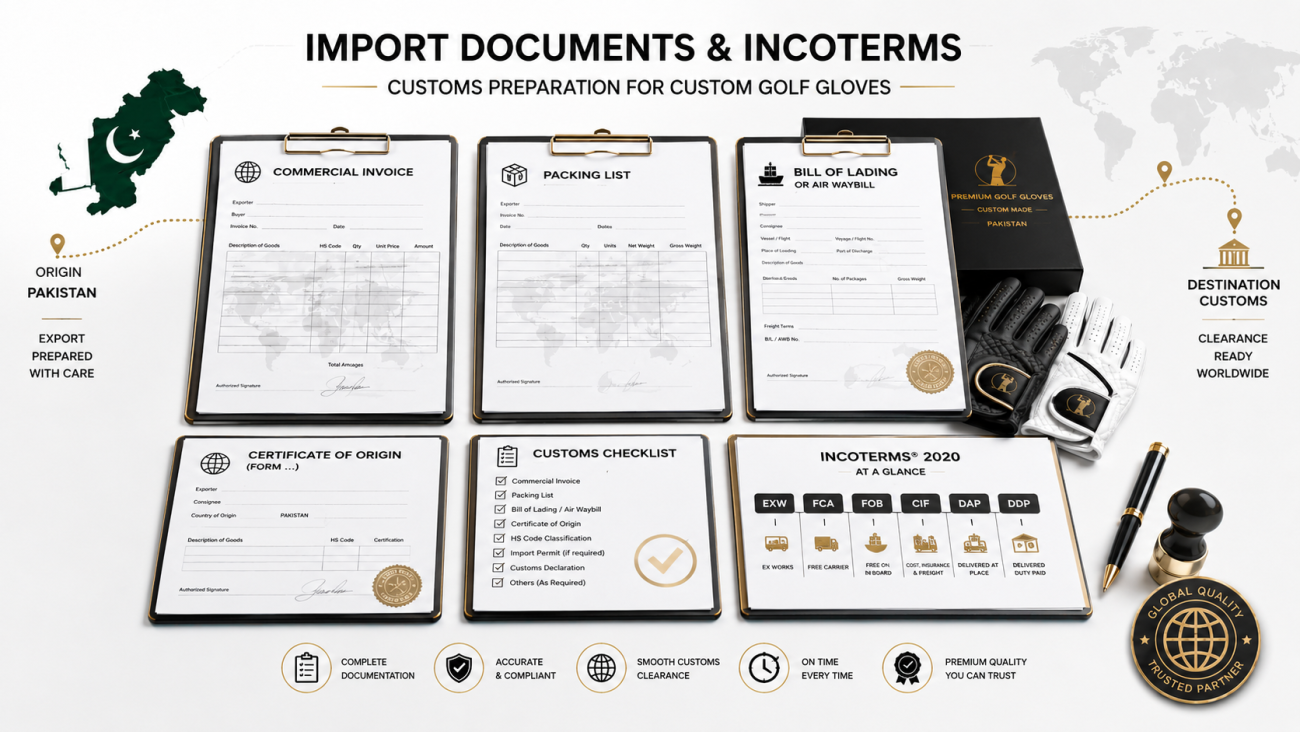
Plan for at least five core records: commercial invoice, packing list, air waybill or bill of lading, customs declaration, and purchase order or contract. A certificate of origin, insurance certificate or inspection report may also be required.
Commercial invoice essentials
- Exporter and importer details
- Invoice number and date
- Accurate material and product description
- Quantity, unit price and total value
- Currency, origin and Incoterm with named place
Incoterms in plain language
| Rule | Practical use | Buyer concern |
|---|---|---|
| EXW | Buyer controls almost all transport | Export handling in Pakistan must be clear |
| FCA | Useful for buyer-controlled air, courier or multimodal shipments | Name the exact handover place |
| FOB / CIF | Sea or inland-waterway transport only | Do not use them for air freight |
| DAP | Supplier delivers to the named destination place | Buyer usually handles import clearance and charges |
| DDP | Supplier promises duty-paid delivery | Verify the lawful importer and tax responsibility |
✈️ Shipping, Customs and Landed Cost
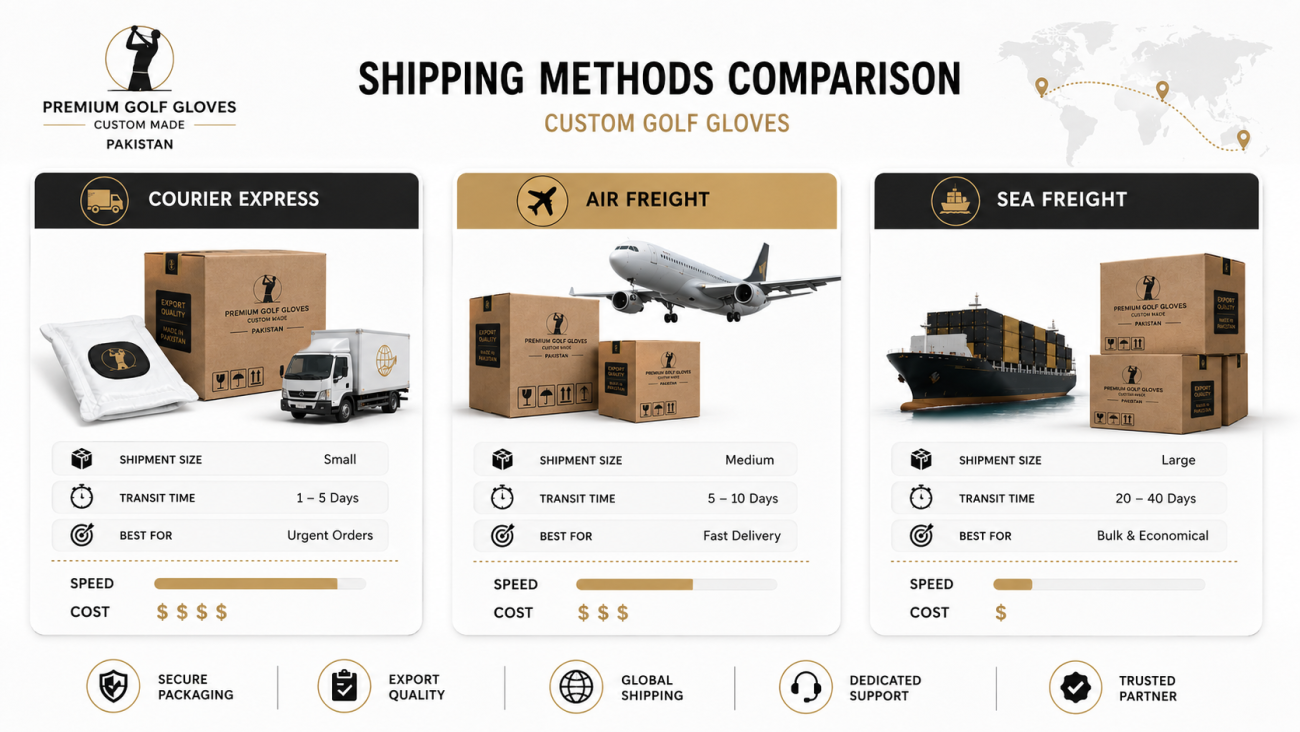
| Method | Planning range | Best use |
|---|---|---|
| Courier | 3–7 business days | Samples and small urgent shipments |
| Air freight | 5–10 business days | Time-sensitive commercial orders |
| Sea freight | 25–45 days port to port | Larger, less urgent shipments |
Customs classification
There is no single safe HS code for every golf glove. Give the broker four facts: palm material, backhand material, leather or synthetic share, and intended use.
Landed-cost formula
Add product, sampling or tooling, packaging, inspection, export charges, freight, insurance, duty, tax, brokerage and local delivery.
✅ Quality Control and Export Packaging
The approved sample should become the reference for production and inspection.
Check the bulk order before shipment
- Material and colour match the approved reference
- Measurements match the size chart and tolerances
- Left-hand and right-hand quantities match the matrix
- Stitching, seams, perforations and closures are secure
- Logo size, colour and position are consistent
- Size, hand, origin and barcode labels are correct
- Packaging and carton quantities match the purchase order
Packaging options
- Protective individual bag
- Paper sleeve or header card
- Retail box or premium presentation box
- SKU, barcode, size and glove-hand labels
- Country-of-origin and care information
- Outer-carton marks, quantities and destination
✅ 40-Point Buyer Checklist
Product and supplier
- Legal identity verified
- Factory capability reviewed
- Bank beneficiary confirmed
- Target customer defined
- Material written clearly
- Size chart approved
- Glove-hand matrix confirmed
- Artwork approved
- Labels approved
- Master sample retained
Commercial and quality
- MOQ explained by variant
- Unit-price scope understood
- Sample charges recorded
- Payment milestones written
- Production start defined
- Inspection timing agreed
- Defect criteria written
- Specification versioned
- SKU matrix checked
- Reorder records planned
Freight and documents
- Incoterm and named place written
- Freight mode selected
- Carton dimensions supplied
- Forwarder appointed
- Broker appointed
- Invoice reviewed
- Packing list checked
- Transport details checked
- Consignee verified
- Contingency time added
Customs and landed cost
- Importer identified
- Registration confirmed
- Composition sent to broker
- Tariff classification reviewed
- Duty estimate obtained
- Origin marking checked
- Labels reviewed
- Destination charges requested
- Landed cost calculated
- Margin still works
❓ Frequently Asked Questions
🔗 Authoritative Resources
Pakistan-side digital trade and declaration information.
Visit PSWCommon export documents and shipping records.
Review the guideOfficial Incoterms resources.
Review IncotermsCommercial-invoice and customs-document guidance.
Review documentsTariff and market-access research.
Open the toolInternational trade-flow research.
Open Trade Map